Definition
Compatibility Score: a numeric or probabilistic estimate, generated by a matching algorithm, of how likely two users are to engage positively with each other. It is calculated from a blend of stated attributes, observed behavior, and trust signals, and it updates continuously as new data arrives.
A compatibility score is not a measurement of romantic destiny. It is a prediction, built the same way a recommendation engine predicts which movie a viewer will watch next or which product a shopper will buy. The score estimates the probability of a specific outcome, usually a mutual match, a sustained conversation, or a date, based on patterns the system has already observed. Two people can share every listed interest and still receive a low score, because the algorithm has learned that shared interests alone predict outcomes poorly. Two people with almost nothing in common on paper can score highly, because their behavioral patterns resemble those of pairs who historically engaged well. Understanding what actually feeds that number, rather than assuming it reflects personality compatibility, is the first step toward building or evaluating a matching system correctly.
Compatibility Scores Are Dynamic, Not Static
A score calculated on day one and a score calculated on day ninety for the same user pair are rarely identical, even if neither person edited their profile. This happens because the underlying inputs fall into two categories. Explicit preferences are what a user states directly: age range, distance, relationship goal. Implicit preferences are inferred from behavior, meaning who they actually message, linger on, or reply to quickly. Well-designed systems treat the second category as a correction mechanism for the first, continuously narrowing the gap between what someone says they want and what their actions suggest they respond to. This continuous learning process means the algorithm's model of a single user keeps shifting, which is why match quality tends to improve the longer a person stays active on a platform.
Misconception: a compatibility score is a fixed property of two profiles, similar to a horoscope match.
Key Insight: compatibility scores are recalculated relationships between a live behavioral model and a live candidate pool, not one-time snapshots.
Profile Attributes: The Starting Point
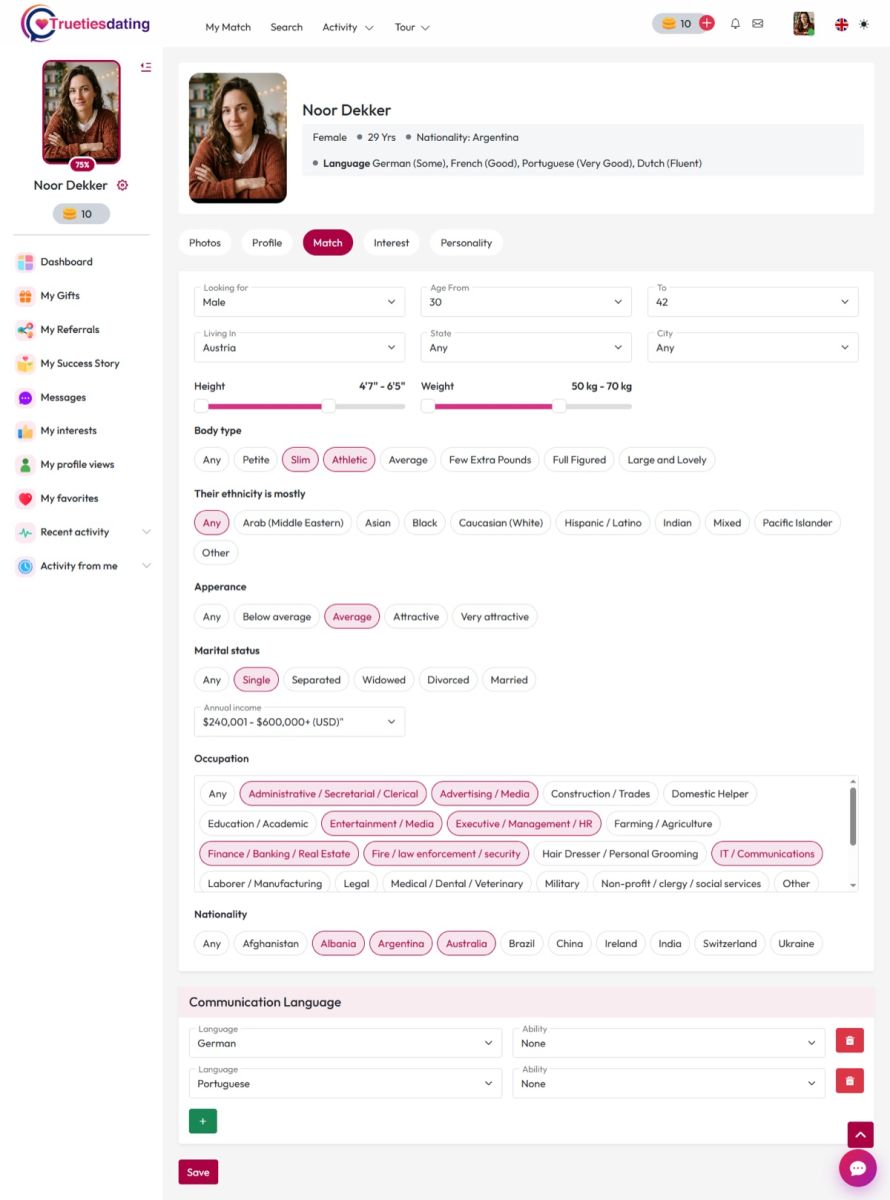
Every scoring system begins with structured profile data because it is cheap to collect and easy to filter on. Common attributes include age, distance, stated relationship goal, languages spoken, lifestyle choices such as drinking or smoking, education level, occupation, and declared interests. These fields serve two functions. First, they act as hard filters that remove obviously incompatible candidates before any scoring happens, which keeps the candidate pool computationally manageable. Second, they provide a baseline similarity signal for brand-new users who have no behavioral history yet.
The limitation is well documented: self-reported attributes are subject to social desirability bias and aspirational answering. A user might list hiking as an interest because it signals an active lifestyle, not because they actually hike. Profile data predicts who a person wants to appear to be. Behavior predicts who they actually respond to.
Example: a platform that ranks matches purely by shared listed interests will consistently surface pairs who never message each other, because interest overlap correlates weakly with conversational chemistry.
Key Insight: profile attributes function as a filtering layer, not a ranking signal, once sufficient behavioral data exists for a user.
Behavioral Signals Often Carry More Weight
Once a user has generated enough activity, platforms shift weight toward observed behavior: swipe direction and speed, how long a profile is viewed before a decision, who initiates conversations, reply rate, the time gap between replies, how long conversations run before fading, which in-app features get used, and how often the user opens the app. A recent breakdown of Tinder, Hinge, and Bumble's ranking mechanics found each platform building response behavior directly into the ranking system, using tools such as unanswered-conversation limits and match-expiration windows that pressure daily engagement and, in turn, generate exactly the behavioral data the algorithm needs to keep refining its model.
Behavioral signals carry more predictive weight because they are harder to fake and less filtered through self-image. A user can claim to want a serious relationship in their profile while consistently engaging with people who signal something more casual. Systems built on this data learn, over time, not to take stated preferences too literally when they conflict with revealed behavior.
Insight: behavioral consistency often predicts engagement more accurately than identical interests, because interaction patterns reveal actual preferences instead of stated preferences.
Key Insight: the gap between what a user says and what a user does is itself a usable signal, not noise to be filtered out.
How Recommendation Systems Calculate Similarity
Underneath the scoring layer, most platforms rely on some combination of three recommendation approaches. Collaborative filtering looks at patterns across the whole user base: if users who behaved like a given person tended to respond well to a certain type of profile, that profile gets recommended to them too, regardless of whether it matches their stated attributes. Content-based filtering instead compares the attributes and content of profiles directly to each other, independent of what other users did. Hybrid models combine both, typically leaning on content-based similarity for new users who have no behavioral history, then shifting weight toward collaborative filtering as interaction data accumulates.
| Approach |
How It Works |
Strength |
Weakness |
Best For |
| Collaborative Filtering |
Recommends candidates based on patterns across similar users, independent of profile content. |
Surfaces non-obvious matches that content similarity would miss. |
Needs substantial interaction history; struggles with new users or new candidate pools. |
Active users with an established behavioral history. |
| Content-Based Filtering |
Compares profile attributes and content directly, without reference to other users. |
Works immediately, even with zero interaction data. |
Tends to recommend narrow, self-similar matches and misses unexpected fits. |
New users with no behavioral history yet (cold start). |
| Hybrid Models |
Blends both approaches, weighting content similarity early and collaborative signals as data accumulates. |
Balances immediacy with accuracy as the user matures on the platform. |
More complex to build, tune, and maintain than either method alone. |
Most production dating platforms at scale. |
The hybrid approach exists specifically to solve the cold-start problem: a brand-new user has no interaction history for collaborative filtering to work with, so the system falls back on profile similarity until enough behavioral data accumulates to make peer-based predictions reliable.
Key Insight: no major platform runs one method exclusively. The engineering challenge is deciding when to trust behavioral similarity over profile similarity, not choosing one method permanently.
Compatibility Is More Than Shared Interests
Beyond raw similarity, several higher-order patterns tend to outperform simple interest matching: communication style consistency, response reliability, activity-level alignment (a highly active user paired with a rarely active one tends to produce poor outcomes regardless of stated interests), mutual engagement depth, lifestyle compatibility, and personality indicators inferred from writing style and interaction cadence. Match Group has invested heavily here, committing significant product spend toward features that pair users on behavioral signals rather than surface-level profile data, while tracking how conversations evolve over time, including which ones fizzle and which lead to real dates, and feeding that outcome data back into the matching model.
Misconception: matching people with identical interests produces the best outcomes.
Insight: two people who both list travel as an interest tell the algorithm almost nothing about whether they will enjoy talking to each other. Two people whose message-reply timing and conversation length resemble a platform's historically successful pairs tell it a great deal more.
Key Insight: outcome-based signals, not attribute-overlap signals, are what separate a mature matching system from a basic filter.
Trust Signals Influence Compatibility
A high raw compatibility score is worthless if one side of the match is not a real, engaged person. Trust and safety scoring runs as a parallel layer that can suppress or override compatibility rankings entirely. This includes identity verification, spam and bot detection, fake-account identification, behavioral risk scoring, and human or automated moderation. The scale of the problem is significant: one platform's automated deception-detection system blocked the large majority of accounts identified as spam or scam during testing and meaningfully cut user reports of fake profiles within two months of rollout. Separate industry research on AI-powered photo verification found it can reduce fake profiles substantially, underscoring how much of the compatibility-scoring pipeline is really a fraud-filtering pipeline wearing a matching label.
Example: a platform that ranks a candidate highly on behavioral similarity but flags them as high fraud-risk will typically suppress that match entirely rather than let the compatibility score override the risk signal.
Key Insight: trust scoring functions as a gate, not an input. A candidate with a low trust score gets excluded before compatibility calculations matter.
Machine Learning Makes Compatibility Adaptive
The scoring model itself is not static code; it runs on a feedback loop. Every match, message, and unmatch becomes a labeled outcome that feeds back into the model, which is periodically retrained to reflect current behavior rather than behavior from months earlier. This matters because preferences drift. A user's stated and revealed preferences at signup often diverge from their preferences a year later, and a model trained once and never updated grows steadily less accurate. New users present the cold-start problem described earlier, since there is no behavioral history to learn from, which is why most platforms fall back on demographic and content-based similarity until sufficient interaction data accumulates, typically within the first few sessions.
Key Insight: a compatibility score is only as good as its most recent retraining cycle, which is why platforms that update models frequently tend to outperform ones that treat the model as a one-time build.
More Blog: Will AI Make Dating Apps Better or Worse? The Truth You Need to Know
Limitations of Compatibility Scores
No scoring system captures everything that determines whether two people connect. Context matters: a great match on a bad day looks identical in the data to a poor match. Chemistry, the intangible sense of attraction and rapport that emerges in person, has no clean digital proxy. Bias can creep in when historical outcome data reflects existing platform demographics or past discriminatory patterns, and a model trained on that data can reproduce it. Privacy constraints limit how much behavioral data a platform can ethically or legally collect, particularly around sensitive inferred attributes. And every model works with incomplete data: a user who rarely opens the app, or who meets someone off-platform after a first message, generates an outcome the algorithm never sees and therefore cannot learn from.
Key Insight: a compatibility score is a probability estimate built on partial, sometimes biased data. Treating it as a definitive verdict on two people's potential overstates what the underlying data can support.
Key Takeaways
- A compatibility score predicts interaction likelihood; it does not measure romantic destiny.
- Profile attributes filter candidates. Behavioral data ranks them.
- Behavioral signals outperform stated preferences because they are harder to fake.
- Hybrid recommendation models blend collaborative and content-based filtering to solve the cold-start problem.
- Trust and safety scoring acts as a gate that overrides compatibility ranking, not an input to it.
- Models are retrained continuously. A static model degrades as user preferences drift.
- No scoring system fully captures chemistry, context, or off-platform outcomes.


